
The Challenge
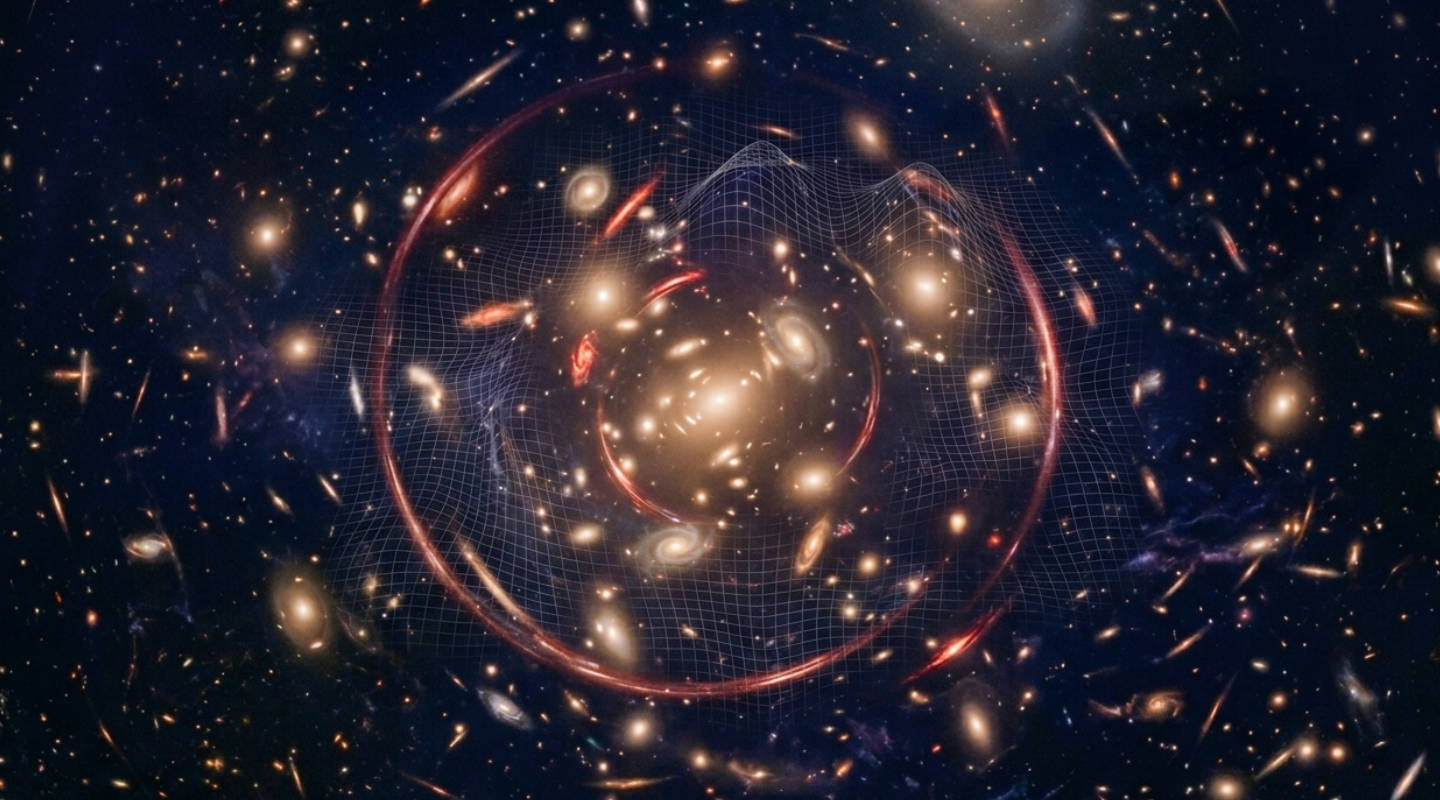
The epoch of reionization—when the first light sources produced enough energetic photons to ionize the neutral hydrogen in the early Universe—is one of the least understood eras in cosmic evolution. While the James Webb Space Telescope (JWST) and Euclid provide dazzling data that could answer key questions about this era, a significant bottleneck remains: the creation of accurate magnification maps using constraints from gravitational lensing. Current reconstruction methods often lack a sophisticated treatment of matter distribution or the capacity to handle the increased complexity and order-of-magnitude increase in constraints provided by JWST data.
Project Vision
The FLEW project aims to develop a new, state-of-the-art combined strong and weak lensing reconstruction method to overcome current mass-modelling limitations. By leveraging deep observations from the most powerful cosmic telescopes (JWST and Euclid), the project seeks to reconstruct the magnification distribution of galaxy clusters with unprecedented precision. This work will provide the crucial infrastructure needed to establish the timeline of reionization and the specific role galaxies played in this process.
Project Goals & Objectives
- Advanced Lens Modelling: To develop a free-form lens modelling code that parametrizes mass distribution with a grid, allowing for the reconstruction of dark matter independently of luminous matter.
- High-Dimensional Data Analysis: To implement sophisticated data analysis techniques, including full Monte-Carlo-Markov-Chain (MCMC) sampling of large parameter spaces (≳ 3000).
- Infrastructure Optimization: To create a user-friendly Python interface and update the infrastructure to allow for parallelization and the processing of massive datasets in collaboration with ACEX Ltd.
- Validation and Application: To test and validate the method on a sample of the six most powerful cosmic telescopes and apply it to 60 clusters imaged as part of the VENUS program.
- Multi-Mission Applicability: To investigate and confirm the applicability of these new methods to data from the Euclid mission, which is expected to find thousands of galaxy clusters.
Innovation & Impact
The core innovation of FLEW lies in its ability to simultaneously combine strong and weak lensing data from JWST without relying on simply parametrized models, superseding the resolution of previously inferred magnification maps.
Successful execution of the project is expected to yield:
- Scientific Legacy: A significant contribution to JWST data reduction and the broader understanding of the early Universe.
- Publicly Accessible Tools: The delivery of final lens models and magnification maps for 60 clusters to be made available to the global astronomy community.
- Enhanced Research Capabilities: Providing a valuable tool for future lensing analyses of JWST observations over its planned 20-year lifetime.
Partners
- University of Ljubljana, Faculty of Mathematics and Physics (UL FMF): Leading the scientific effort, including data reduction, analysis, and lens model construction.
- ACEX Ltd.: Providing expert AI assistance and participating in the development of advanced reconstruction and parallelization methods.
Similar projects
- Astro2RV - Inference of radial velocities (RV) from astrometric stellar data.